

Represented by Mr Hicham MELLATI, Director of Criminal Affairs and Pardons at the Ministry of Justice and President of the CNCLT, the Moroccan experience was presented at the annual meeting of National Anti-Trafficking Coordinators and Rapporteurs.
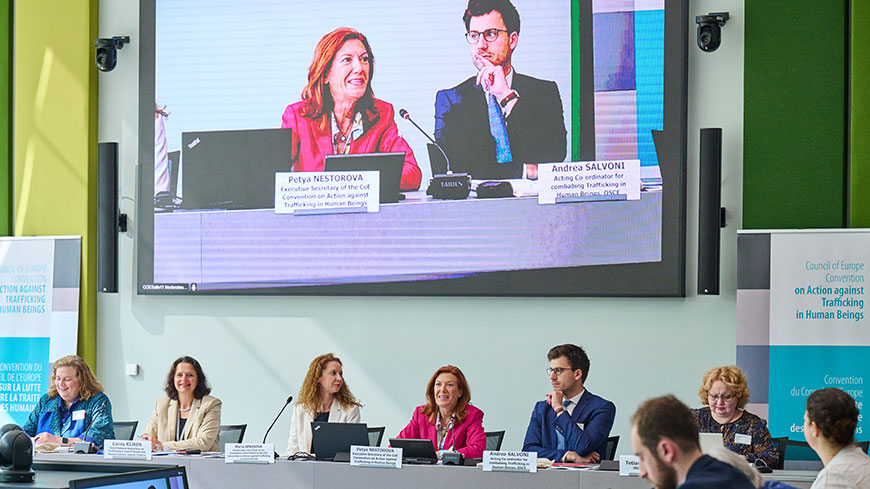
How can national anti-trafficking structures be strengthened? This question was at the heart of the largest annual meeting of National Anti-Trafficking Coordinators and Rapporteurs, held at the headquarters of the Council of Europe in Strasbourg, France, on 6 and 7 June 2023. The meeting was co-organised by the Office of the OSCE Special Representative and Co-ordinator for Combating Trafficking in Human Beings (OSR/CTHB) and the Council of Europe.
More than 130 participants, representing nearly 60 countries from the Council of Europe and OSCE regions and beyond, including Morocco, gathered to discuss ways of strengthening the mandates and roles of National Anti-Trafficking Coordinators and Rapporteurs (NACs and NARs) or equivalent mechanisms.
These are essential elements of an effective national anti-trafficking strategy, preferably placed at a high-level position within government, in order to better leverage, direct and harmonise the various instruments for combating trafficking and maximise their impact.
“Today, the high risk of exploitation means that there is an urgent need and obligation to act. Succeeding in overcoming the challenges we face requires national leadership,” stressed OSCE Secretary General Helga Maria Schmid in her welcome address.
Andrea Salvoni, Acting Co-ordinator of the OSCE OSR/CTHB, added in his opening remarks that “unfortunately, States are still not doing enough to identify and protect victims of trafficking. Indeed, the data tell us that fewer than 1% of all trafficking victims are identified, and far too few of those who are identified receive the services and support they need, tailored to their specific vulnerabilities and circumstances”.
“Our collective duty is to ensure that combating trafficking in human beings remains at the top of the political agenda at national, regional and international levels,” said Maria Spassova, Vice-Chair of the Committee of the Parties to the Council of Europe Convention on Action against Trafficking in Human Beings. “The Reykjavík Declaration, recently adopted by the Heads of State and Government of the Council of Europe, underlined the need to combat trafficking and to step up international cooperation,” she added.
“The annual meetings of National Anti-Trafficking Coordinators and Rapporteurs provide a platform for the exchange of information and ideas, and strengthen their determination to steer action against trafficking in human beings in the face of new challenges and competing priorities,” concluded Petya Nestorova, Executive Secretary of the Council of Europe Anti-Trafficking Convention.
Better identifying and assisting foreign victims of transnational trafficking, strengthening the proactive use of financial investigations, understanding and addressing trafficking in human beings for the purpose of forced criminality, and strengthening the mandates and roles of national coordinators and rapporteurs were among the items on the agenda of the working sessions during this two-day meeting.


