

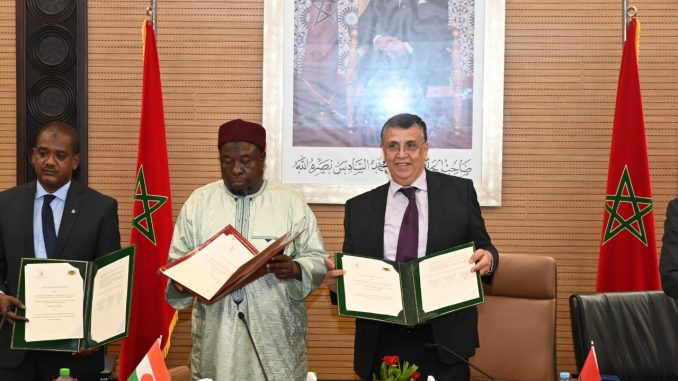
On the sidelines of the commemoration of the World Day against Trafficking in Persons, celebrated on 30 July each year, the Minister of Justice welcomed, on Monday 1 August 2022 at the headquarters of the Ministry in Rabat, a high-level delegation from the Republic of Niger, led by Mr Moumouni HAMIDOU, President of the National Commission for the Coordination of the Fight against Trafficking in Persons and the Smuggling of Migrants in Niger.
This meeting took place within the framework of strengthening African cooperation in combating trafficking in human beings and the smuggling of migrants. Following the meeting, a declaration of intent was signed between the National Commission for the Coordination of Measures to Combat and Prevent Trafficking in Human Beings, whose presidency and permanent secretariat are provided by the Ministry of Justice, on the one hand, and the National Commission for the Coordination of the Fight against Trafficking in Persons and the Smuggling of Migrants and the National Agency for the Fight against Trafficking in Persons and the Smuggling of Migrants of the Republic of Niger, on the other hand, on the occasion of the commemoration of the International Day against Trafficking in Persons.
Speaking at the ceremony, the Minister of Justice, Mr Abdellatif OUAHBI, emphasised the remarkable momentum that Morocco has experienced, under the leadership of His Majesty King Mohammed VI, in developing a holistic national strategy based on a participatory approach to immigration, asylum and trafficking in human beings, which led to the promulgation in 2016 of anti-trafficking Law 27.14.
The promulgation of this law, he stressed, strengthened the national legal system by establishing a definition of trafficking in human beings in line with international standards, classifying it as a crime and recognising the criminal liability of any legal person that commits it, while highlighting the obligation to confiscate the means used and to carry out checks for the identification and protection of victims, in addition to protecting witnesses, experts, victims and whistle-blowers.
He also noted that a National Commission had been established to coordinate the efforts of all its components (government departments, public institutions and civil society associations) to combat this crime and eliminate its sources, in accordance with a well-structured National Plan of Action developed on the basis of a participatory approach that respects the remit of each sector and contributes to the complementarity of the missions of the various stakeholders. The presidency of the National Commission for the Coordination of Measures to Combat and Prevent Trafficking in Human Beings, established under the Head of Government, has been delegated to the Ministry of Justice, which also provides its Permanent Secretariat.
Furthermore, according to the Minister, engaging in the process of accession to bilateral and multilateral international conventions is an important step that would help reduce criminal phenomena by strengthening international cooperation in various fields, whether in civil or criminal matters.
In this regard, Mr OUAHBI indicated that the Ministry of Justice has concluded 79 judicial cooperation agreements in criminal matters with various countries, whether European, American, African, Asian or Arab, stressing that these agreements encompass various internationally recognised mechanisms and means in the field of combating and dealing with crime, whether through extradition, letters rogatory or official complaints, in addition to strengthening this cooperation through the mechanism for the transfer of sentenced persons so that they may serve the remainder of their sentence in their own country.
He specified that the National Commission for the Coordination of Measures to Combat and Prevent Trafficking in Human Beings remains open to any proposal for cooperation with its Nigerien counterpart and places the experience, good practices and skills of its members at its disposal, whether in terms of prevention and capacity-building in the field of criminal investigation, the identification of presumed victims of this crime, or raising awareness among citizens, practitioners and civil society associations of its impact on individuals and communities.
Morocco, an example of “good practice”.
For his part, the President of the National Commission for the Coordination of the Fight against Trafficking in Persons and the Smuggling of Migrants in Niger, Moumouni Hamidou, indicated that Morocco has accumulated significant experience in this field and has made considerable efforts to combat crime in general and trafficking in human beings in particular, which “will enable us to benefit from good practices within the framework of cooperation between African countries to combat trafficking in human beings”.
Finally, it should be noted that the National Commission for the Coordination of Measures to Combat and Prevent Trafficking in Human Beings is organising a series of activities during the period from 25 July to 5 August, in partnership with the Morocco office of the United Nations Office on Drugs and Crime and the European Union. These include a joint mock investigation and trial on cases of trafficking in persons and smuggling of migrants, to be held in Casablanca from 2 to 5 August.


